Click on the toggle button above for full screen slideshow
THE ROUTES OF THE UNDERGROUND CATHEDRAL
It all started as an innocent joke, which looking back seems to make sense, for my first independently conceived “autonomous” stained glass artworks were born in humorous if not satirical origins, as I have described here: “Early Stained Glass Artworks.”
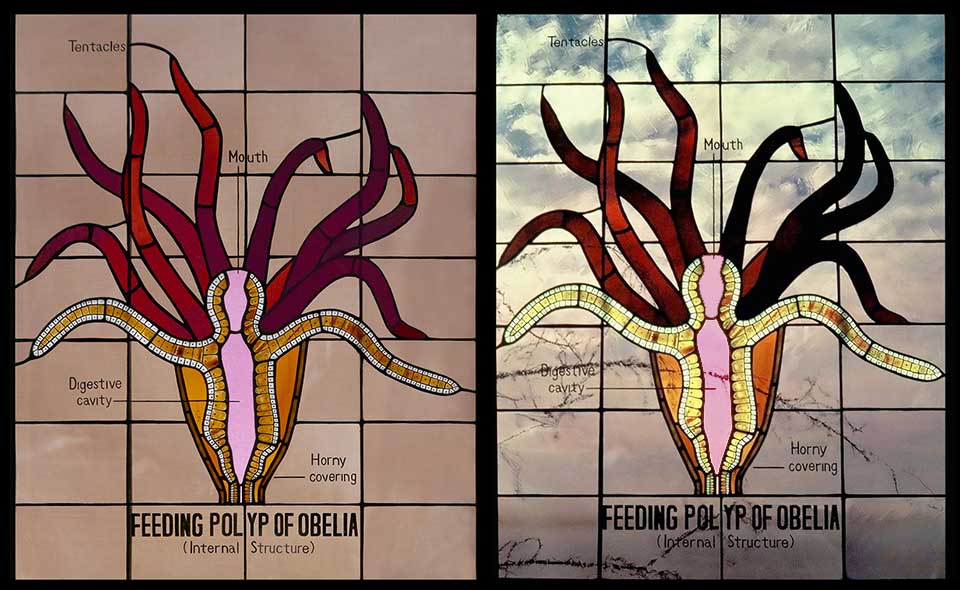
My first art studio outside of my home was in a building in West Los Angeles that contained studios of nine other artists. One day I showed a little book from my childhood, called, “The Seashore,” to one of them, I pointed to an image of a jellyfish, commented that its glassy nature might somehow become an appropriate subject of a stained glass artwork. He pointed to the adjoining page of a technical diagram of what is known as a “hydra,” a plant animal with roots at the bottom of the sea, poisonous tentacles which kill fish that are passing by and devours them with a mouth. He laughed and said, “Why don’t you make an artwork from that?”
From birds and flowers to a Siamese Fighting Fish to “Feeding Polyp of Obelia (Internal Structure),” the first known forms of life on earth, which are still found on the floor of the ocean, became the subjects which resulted in a life-long project, The Underground Cathedral.
How this concept evolved is described by clicking here


Feeding Polyp of Obelia (Internal Structure)
29 x 35 inches, 1974

Anterior Nervous System of a Chambered Nautilus
29 x 47 inches, 1975

Sleeping Georgina: Sectional Diagram of a Zooid or Proposal Diagram for a
Los Angeles Subway System
2 x 8 feet, 1976
I imagined a mapping of a subway system, something Los Angeles sadly lacked.
In 1976, I was commissioned to create a stained glass window for the top two rows of a large-paned French window of a private residence in Santa Monica, California. This was the first time I was given total artistic freedom to design and execute a permanent architectural installation.
Up to that point in my career, I had usually designed such windows using Gothic, Art Nouveau or Art Deco styles, which was what most clients wanted. (Some of these works can be seen by clicking here.)
It had also dawned on me that a stained glass window was not only an illuminated enhancement of an interior – it simultaneously interacts with the exterior. I became mindful of the dynamic role of the outside environment: an artwork is affected not only by what can be seen through a window but also by the transitions outside from sunrise to sundown, as well as seasonal transformations of the incoming light.
All of these factors were taken into account as I embarked on a rather unconventional approach. It was directly connected to the independent (or what glass artists called “autonomous”) stained glass artworks I had made prior to this commission, but for no particular architectural or environmental purpose at all. (Nevertheless, as one can see from the two prior examples, placement of these artworks changes how they appear depending on the light source and on what is or isn’t visible through their surface. This further depends on what type of glass is used, what textures it may have and what is its degree of transparency.

I went further with this experimental architectural concept: I handed out photocopies of my design along with colored pencils, asking students, I was privately teaching at the time, to come up with a color scheme. Here are three examples of the results. The colors I ultimately selected came out of this experiment.

The complicated title of the work derives from several sources. Outside of the window one can see the name of the street where the home is located, Georgina (seen in the background full-screen slide show). The actual diagram from a zoology book was presented as a vertical form, but I placed it horizontally, giving it the title, “Sleeping Georgina.” Aside from its proper biological description, “Sectional Diagram of a Zooid,” in all of these shapes I discovered allusions to other subjects, whether springing from my own knowledge and imagination or from comments other people have made. For example, one person said the “Chambered Nautilus” looked like a space creature, whereas someone else saw in it an upside down artichoke. In this case, I imagined a mapping of a subway system, something Los Angeles sadly lacked. Finally, I created a glossary of relevant terms pertaining to the long title of this project: